





Brighton Dome reopens
Brighton Dome’s historic Grade I and Grade II listed Corn Exchange and Studio Theatre have reopened for live performances following a six-year refurbishment.
The work is the first phase of a regeneration project by Brighton and Hove City Council, in partnership with Brighton Dome and Brighton Festival and Brighton and Hove Museums, to cement the Royal Pavilion Estate as a landmark destination for heritage and the arts. The refurbished spaces have been designed by Feilden Clegg Bradley Studios.
The original wooden beams of the Corn Exchange’s timber frame have been repaired, strengthened and restored to designs by the building’s original architect, William Porden, in the early 1800s. The Studio Theatre’s original features, such as crenelated windows that mimic the character of the Royal Pavilion, have been conserved and its ceiling replaced with a new yet historically accurate version. Its exterior has been restored and repaired.
The Grade I listed Concert Hall and Corn Exchange were originally commissioned in 1803 as a stable block and riding house to accompany the Prince Regent’s extravagant seaside palace, the Royal Pavilion. William Porden took inspiration from the Jama Masjid (Friday Mosque) in Delhi for the stable’s exterior, and the glass ceiling of the huge domed roof owed a debt to the Paris Corn Exchange. The dimensions of the riding house were equally ambitious, its 18-metre-wide single span timber roof remaining the largest in the country.
The stables were used as a cavalry barracks until the interior was remodelled as a concert and assembly hall, and reopened in 1867. The riding house reopened in 1868 as a Corn Exchange. In 1934 and 1935, both the Concert Hall and Corn Exchange were refurbished by architect Robert Atkinson. The Concert Hall received a radical art-deco redesign, and the Corn Exchange was repurposed as a single, grand room for exhibitions and functions.
This article originally appeared in the Institute of Historic Building Conservation’s (IHBC’s) Context 179, published in March 2024.
--Institute of Historic Building Conservation
Related articles on Designing Buildings
IHBC NewsBlog
IHBC sponsors Gardens Trust event 23-4 Sept 2026
.jpeg)
'Learning from the Past, Shaping the Future’ takes place in Milton Keynes
Renovations to Frank Lloyd Wright's Fallingwater complete
.jpg)
World Heritage Preserved project opens house for tours again
Shakespeare Birthplace Trust places Hall's Croft on HAR Register
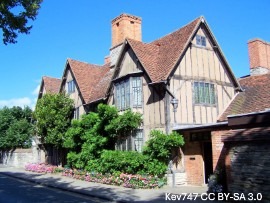
Stratford-upon-Avon home of Shakespeare's daughter is 'At Risk'
Lady Grange’s House repaired on St Kilda
.jpg)
National Trust for Scotland repairs stone cleit with link to famous island resident
Griff Rhys Jones on BBC Radio 4 Today programme
,_Green_Lane,_Derby.jpg)
The Victorian Society’s President unveiled its latest Top Ten Endangered Buildings 2026.
Need a MATE? Book your place now.
IHBC offers free webinars on applying for IHBC accreditation (Full & Associate).
UK Stained Glass Repository finds windows new homes
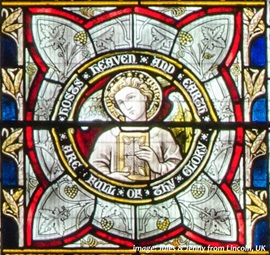
How are stained glass windows are rescued, stored and repurposed?
APPGEBE report sets high aims for quality
'Government must not sacrifice quality in drive to build 1.5m homes'
New measures protect Historic Shipwrecks from heritage crime

Underwater cultural heritage benefits from new HE guidance
How could the City of London skyline look in 6 years' time?

Visualisation shows approved planning applications as completed buildings
National Trust for Scotland calls for VAT cuts
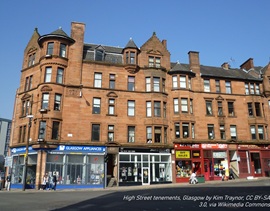
Heritage neglect is encouraged by current policies
IHBC's 'Context' Issue 186 features Industrial Heritage
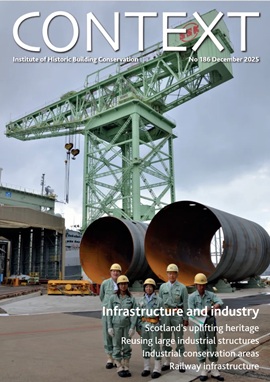
IHBC's members' journal reports on the challenges of conserving infrastructure
Book now for IHBC Annual School 2026
IHBC Annual School is taking place 18-20 June 2026 in Newcastle
RICHeS Research Infrastructure offers ‘Full Access Fund Call’
RICHeS offers a ‘Help’ webinar on 11 March
Latest IHBC Issue of Context features Roofing
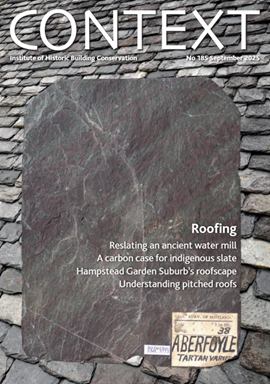
Articles range from slate to pitched roofs, and carbon impact to solar generation to roofscapes
Three reasons not to demolish Edinburgh’s Argyle House

Should 'Edinburgh's ugliest building' be saved?
IHBC’s 2025 Parliamentary Briefing...from Crafts in Crisis to Rubbish Retrofit
IHBC launches research-led ‘5 Commitments to Help Heritage Skills in Conservation’
How RDSAP 10.2 impacts EPC assessments in traditional buildings

Energy performance certificates (EPCs) tell us how energy efficient our buildings are, but the way these certificates are generated has changed.